In This Article
- Why Mortgage Compliance Got Harder in 2026
- What Power BI Actually Does for Compliance Teams
- Why Mortgage BI Is Not the Same as Standard Power BI
- Five Compliance Templates Mortgage BI Pre-Builds
- The Microsoft Purview Evidence Layer Beneath the Dashboard
- Building the Business Case for Real-Time Monitoring
- The Implementation Playbook
- How ABT Gets You There Faster on Mortgage BI + MortgageExchange
- Frequently Asked Questions
The Homebuyers Privacy Protection Act takes effect March 4, 2026. Fannie Mae's cybersecurity supplement now requires 36-hour breach notification. The CFPB just updated Regulation Z thresholds for qualified mortgages. And New York's Department of Financial Services adopted new CRA rules covering non-bank mortgage bankers in February 2026.
That is four major compliance changes hitting mortgage lenders in the first quarter of 2026 alone. If your compliance team is still tracking regulatory deadlines in spreadsheets, you are already behind.
Power BI templates give mortgage compliance teams a way to monitor these changes in real time. Instead of discovering gaps during audits, dashboards surface problems the moment data drifts outside acceptable parameters. This guide breaks down how to build that capability, why generic Power BI templates fall short for FI-regulated lenders, and how ABT's purpose-built Mortgage BI layer on top of the MortgageExchange data fabric, governed by Microsoft Purview, gets the same dashboards into production in weeks instead of quarters.
Why Mortgage Compliance Got Harder in 2026
Mortgage lenders face more simultaneous regulatory changes right now than at any point since Dodd-Frank implementation. The volume is not the problem. The speed is.
Consider what landed in the first quarter of 2026. The Homebuyers Privacy Protection Act restricts trigger lead usage starting March 4, amending the Fair Credit Reporting Act to require consumer opt-in or an existing relationship before consumer reporting agencies can furnish mortgage-related consumer reports. Lenders relying on trigger leads for acquisition need new marketing workflows immediately.
Fannie Mae's Information Security and Business Resiliency Supplement requires sellers, servicers, and now document custodians (as of April 1, 2026) to maintain formal information security programs aligned with NIST standards, report cybersecurity incidents within 36 hours, and provide annual officer attestation across 14 security domains. That is a material step up from previous requirements.
The CFPB updated Regulation Z thresholds for 2026, adjusting HOEPA loan-amount triggers to $27,592, qualified mortgage points-and-fees thresholds, and the HMDA small-institution exemption to $59 million. Every pricing model, disclosure system, and compliance check needs recalibration.
New York's Department of Financial Services adopted CRA regulations covering non-bank independent mortgage bankers for the first time in February 2026. Lenders operating in New York now face filing, self-testing, and self-assessment requirements similar to those imposed on depository institutions.
Tracking all of this manually is not just slow. It is risky. One missed threshold adjustment can trigger a compliance violation that takes months to resolve.
What Power BI Actually Does for Compliance Teams
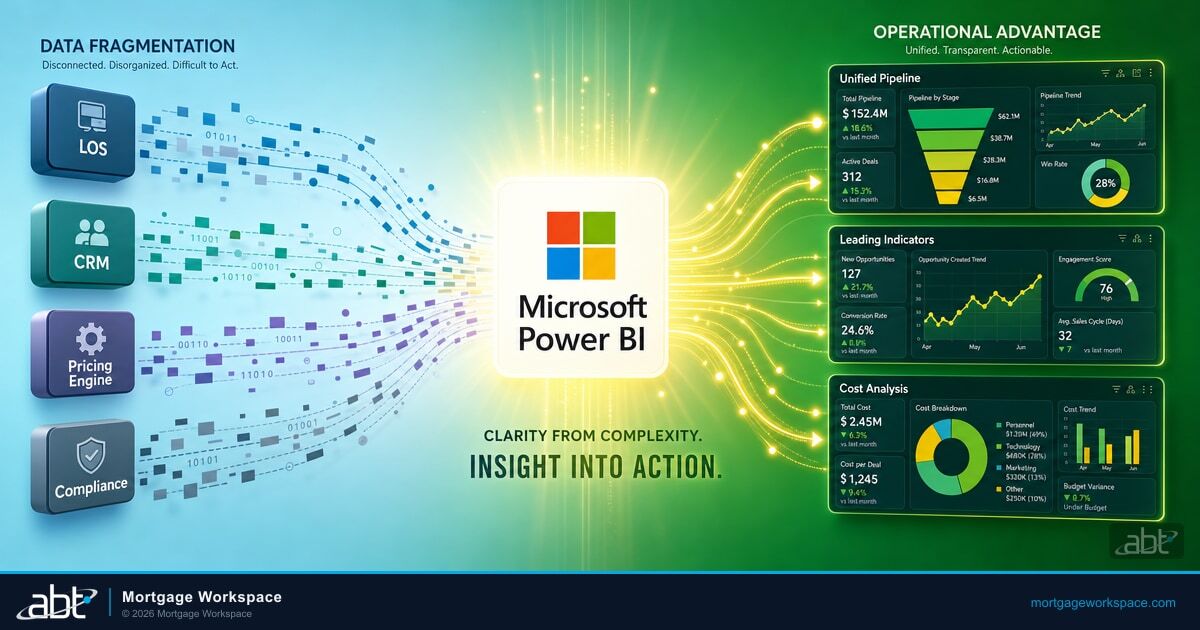
Power BI is Microsoft's business intelligence platform. It connects to your loan origination system, CRM, document management, and financial systems, then turns that combined data into dashboards your compliance team can act on.
For mortgage lenders, that means three things. First, it pulls data from Encompass, Byte, MeridianLink, Calyx PointCentral, or whatever LOS you run into a single view. No more toggling between systems to check disclosure deadlines or qualified mortgage status. Second, it applies rules and thresholds automatically. When a loan's debt-to-income ratio exceeds the qualified mortgage safe harbor limit or a disclosure deadline approaches, the dashboard flags it before a human needs to remember to check. Third, it refreshes on a schedule you set. Daily, hourly, or near-real-time depending on your data architecture.
The difference between Power BI and a spreadsheet is not visual polish. It is that Power BI connects directly to source systems. A spreadsheet is a snapshot. A Power BI dashboard is a live feed.
Power BI also runs natively in the Microsoft ecosystem. If your organization already uses Microsoft 365, Teams, and SharePoint, Power BI slots into existing workflows without adding another vendor relationship or security review. Most mortgage lenders already have Power BI access through their Microsoft 365 subscription. The incremental cost is template design and data integration work.
Why Mortgage BI Is Not the Same as Standard Power BI
Standard Power BI is a general-purpose business intelligence tool. The institution has to design the data model, connect to each upstream system separately, build dashboards from scratch, and maintain them as systems and regulations change. That works at a generic enterprise. For an FI-regulated mortgage lender, it leaves three structural gaps.
The data model is not pre-built for mortgage. A general-purpose Power BI deployment treats loans as transactions and reporting as a query. The compliance team has to specify, by hand, what a TRID disclosure window looks like, how qualified mortgage points-and-fees roll up across the five loan amount tiers, how HMDA demographic categories should aggregate, and how Fannie Mae's 14 security domains map against the firm's controls. Each of those models has to be maintained as thresholds change. The CFPB updated Regulation Z thresholds for 2026. The points-and-fees calculation needs a model update inside every dashboard that touches qualified mortgage status. Standard Power BI does not refresh that model for you.
The data connections are not pre-built for mortgage systems. A standard Power BI implementation needs custom ODBC, REST API, or scheduled-export connectors for every system in scope: Encompass, Byte, MeridianLink, Calyx PointCentral, Symitar, Episys, Jack Henry, FIS, Fiserv DNA, and the institution's escrow and tax-service feeds. Each connector is its own integration project. Each one needs maintenance when the upstream system updates its API.
The compliance evidence layer is not pre-built. A Power BI dashboard shows what is happening now. A regulator wants to see what was happening last quarter, who looked at it, and what action was taken. The Microsoft Purview Audit layer answers that, but only if it has been configured to log the right events across Exchange Online, SharePoint Online, OneDrive, Teams, and Microsoft Entra ID, and only if retention policies bind the records to the right systems for the seven-year retention window most FI examiners expect on books and records.
ABT's Mortgage BI is the layer that closes those three gaps. It is a purpose-built Power BI configuration with pre-built data models for qualified mortgage status, TRID disclosure windows, HMDA demographic aggregation, Fannie Mae InfoSec scorecards, and Regulation Z threshold tracking, sitting on top of the MortgageExchange data fabric that has been moving data between mortgage origination systems and core banking platforms for more than two decades. The Microsoft Purview evidence layer is configured against the same data, so the dashboard the loan officer uses today produces the audit trail an examiner will ask for next quarter.
The reason ABT's Mortgage BI deploys in weeks instead of quarters is that MortgageExchange has been moving data between mortgage origination systems and core banking platforms for more than two decades, against every major LOS and every major core. That interface footprint is the moat. A mortgage banker or credit union does not stand up a parallel analytics team. ABT manages the Microsoft 365 tenant where Mortgage BI runs, hosts the MortgageExchange data layer in Azure, and applies the Microsoft Purview audit and retention surface that turns the dashboard into examination-ready evidence on day one.
Five Compliance Templates Mortgage BI Pre-Builds
1. Qualified Mortgage Status Tracker
This template categorizes every loan in your pipeline as safe harbor, rebuttable presumption, or non-QM. It monitors debt-to-income ratios, loan terms, and total points and fees against the 2026 thresholds, and flags any loan approaching qualified mortgage boundaries before it crosses them.
The dashboard uses a donut chart for qualified mortgage status distribution, a scatter plot mapping debt-to-income against points and fees, and conditional formatting that turns red when a loan falls outside safe harbor parameters. Branch managers see their pipeline. Executives see the enterprise view. The CFPB's 2026 threshold update is already wired in.
2. Disclosure Deadline Monitor
TRID requires Loan Estimates within three business days of application and Closing Disclosures at least three business days before closing. This template tracks every loan against those deadlines, sorted by urgency. Loans approaching their window get flagged. Loans that missed it get escalated to a supervisor and logged to the Microsoft Purview audit trail.
The template integrates with your LOS through MortgageExchange to pull application dates, estimated closing dates, and actual disclosure delivery timestamps. It calculates business days automatically, accounting for holidays and weekends.
3. Fair Lending Analysis Dashboard
HMDA reporting requires lenders above the $59 million asset threshold to collect and report detailed lending data. This template visualizes approval rates, denial rates, and pricing by demographic category, geography, and product type.
The goal is not just HMDA compliance. It is early detection of patterns that could trigger fair lending scrutiny. If denial rates for one demographic group in one geography deviate significantly from the baseline, the dashboard flags it for review before it becomes a regulatory finding.
4. Cybersecurity Compliance Scorecard
With Fannie Mae's information security requirements, lenders need to track compliance across 14 security domains. This template creates a scorecard that maps your controls against Fannie Mae's supplement and the NIST Cybersecurity Framework. It tracks penetration testing schedules, vulnerability scan results, incident response readiness, and annual officer attestation status.
The 36-hour breach notification requirement means your incident response workflow needs to be documented and rehearsed. This dashboard tracks whether those processes are current and tested, pulling control evidence from Microsoft Defender, Microsoft Sentinel, and Microsoft Purview into the same view.
5. Regulatory Change Impact Tracker
This template monitors regulatory changes from the CFPB, state banking departments, and the government-sponsored enterprises. It maps each change to affected business processes, assigns implementation owners, and tracks progress toward compliance deadlines.
For 2026, this means tracking the HPPA trigger lead restrictions, CFPB threshold updates, the NY DFS CRA requirements, California CCPA amendments affecting automated decision-making, and any new rulemaking from the CFPB on loan originator compensation or personal financial data rights.
The Microsoft Purview Evidence Layer Beneath the Dashboard
A dashboard is what a loan officer sees today. Microsoft Purview is what an examiner asks for next quarter. The two have to be configured together or the dashboard is a productivity tool without a regulatory floor underneath it.
Microsoft Purview Audit produces the time-stamped audit log across Exchange Online, SharePoint Online, OneDrive, Microsoft Teams, and Microsoft Entra ID. Audit Premium extends retention to one year with the option to extend to ten, which matches the practical retention floor most FI examiners expect on books and records. Retention policies bind tamper-evident retention to mailboxes, sites, OneDrive accounts, and Teams channels where loan files, borrower correspondence, and disclosure documents live. Microsoft Purview Information Protection sensitivity labels classify customer non-public personal information so dashboards built on top of MortgageExchange surface the right data to the right role without leaking it to the wrong one.
When an examiner asks for the disclosure timeline on a loan that closed eighteen months ago, the Mortgage BI dashboard shows the current pipeline and the Microsoft Purview audit log produces the supporting evidence. That separation matters: the dashboard is the operational tool; Purview is the regulatory record. Both run inside the Microsoft 365 tenant ABT manages, on top of the MortgageExchange data layer ABT hosts on Azure.
See Mortgage BI configured against your own loan pipeline
ABT configures Mortgage BI on top of MortgageExchange against your origination system, your core banking platform, and your servicing data. The compliance dashboard is live in weeks. The Microsoft Purview audit trail your FFIEC, CFPB, or state examiner expects is live the same day. Inside the Microsoft 365 tenant we already manage for institutions like yours.
Building the Business Case for Real-Time Monitoring
Compliance failures cost more than fines. A single TRID violation can trigger a full audit. A fair lending pattern that goes undetected can result in consent orders, restitution, and reputational damage that takes years to repair.
Real-time monitoring changes the math. Instead of quarterly reviews that find problems after they compound, dashboards catch drift in days or hours. That means smaller corrections, fewer escalations, and cleaner audits.
The operational benefits are concrete. Teams that automate compliance reporting through Mortgage BI spend less time compiling data for auditors and more time on loan production. When examiners arrive, the data is already organized, current, and exportable. That changes the tone of the entire examination.
There is also the vendor consolidation angle. Power BI is included in many Microsoft 365 plans or available as a standalone license. Lenders already paying for the Microsoft stack often have Power BI access they are not using. With ABT, the incremental work is the Mortgage BI configuration, the MortgageExchange data connections, and the Microsoft Purview retention and audit posture, not another SaaS subscription.
The Implementation Playbook
Week 1 to 2: Identify your highest-risk compliance areas. For most lenders in 2026, that means TRID disclosure tracking, qualified mortgage threshold monitoring, and Fannie Mae information security compliance. Start with the Mortgage BI template that addresses your most urgent gap.
Week 2 to 3: Connect your data sources through MortgageExchange. Map which systems hold the data you need, and let the MortgageExchange data layer handle the connections to Encompass, Byte, MeridianLink, Calyx PointCentral, Symitar, Episys, Jack Henry, FIS, Fiserv DNA, and the escrow and tax-service feeds. Validate data quality at the source so the dashboards have clean inputs from day one.
Week 3 to 4: Configure thresholds, alerts, and the Microsoft Purview evidence layer. Set the specific parameters for your organization. Qualified mortgage thresholds change annually, so build in the ability to update limits without rebuilding dashboards. Configure email alerts for critical violations, Microsoft Teams notifications for approaching deadlines, and Microsoft Purview retention policies binding the loan files, disclosures, and borrower correspondence to the records retention window your examiner expects.
Week 4 and beyond: Train and expand. Start with compliance officers and branch managers. Once they validate the dashboards against known data, expand access to loan officers, underwriters, and executives. Each role needs a different view of the same underlying data. Microsoft Entra ID Conditional Access controls which role sees which view, and Microsoft Purview Information Protection sensitivity labels keep borrower non-public personal information visible to the right role and shielded from the wrong one.
The key to successful implementation is starting small and proving value fast. One dashboard that catches a compliance gap in its first week builds more organizational support than a six-month planning exercise.
How ABT Gets You There Faster on Mortgage BI + MortgageExchange
Access Business Technologies has built Microsoft-native technology infrastructure for financial institutions since 1999. We are a Tier 1 Microsoft Cloud Solution Provider, which means we manage your Microsoft 365 tenant under delegated admin and host your Azure environment as the partner of record. We serve more than 750 banks, credit unions, and mortgage companies across the United States.
Our compliance dashboard implementations start with your specific regulatory requirements, not a generic template. We configure Mortgage BI against your loan origination system and core banking platform through the MortgageExchange data layer, set 2026 regulation thresholds, bind the Microsoft Purview retention and audit policies that turn the dashboard into examination-ready evidence, and train your team to maintain and extend the dashboards independently. Most institutions are running a production compliance dashboard within four weeks of kickoff.
Because we work across the full FI vertical, MortgageExchange has been built and battle-tested against data from Encompass, Byte, MeridianLink, Calyx PointCentral, Symitar, Episys, Jack Henry, FIS, Fiserv DNA, and custom platforms. We know the data structures, the integration constraints, and the dashboard layouts that loan officers and compliance teams actually use. We also know how to wire those dashboards into Microsoft Entra ID Conditional Access, Microsoft Purview Audit, and the rest of the Microsoft 365 governance surface that an FFIEC, CFPB, or state examiner expects to see. For institutions still mapping their broader compliance posture, our companion guide on bridging IT and compliance with Microsoft solutions covers the surrounding control set, and the data-driven learning dashboards guide shows how the same Mortgage BI surface supports continuing education for loan officers and members.
Key Takeaway
Generic Power BI templates require an in-house team to build mortgage data models, maintain connectors to every LOS and core, and configure a separate audit layer for examiners. ABT's Mortgage BI sits on top of MortgageExchange and the Microsoft Purview evidence layer inside the Microsoft 365 tenant we already manage for you, so the compliance dashboard your team uses today produces the audit trail your examiner asks for next quarter. The dashboard is the productivity unlock. Microsoft Purview is the regulatory floor. Both ship in weeks, not quarters.
Ready to replace spreadsheet compliance monitoring with real-time dashboards?
Talk to an ABT Mortgage BI specialist. We will map your current Microsoft 365 posture, identify which compliance templates to deploy first, and outline what a Mortgage BI implementation on MortgageExchange looks like for your loan pipeline. No commitment, no quote, no obligation.
Frequently Asked Questions
Power BI connects to Encompass and other loan origination systems through ODBC drivers, REST APIs, or scheduled data exports. Once connected, dashboards pull loan data automatically on the refresh schedule you configure. Most lenders establish daily or twice-daily refreshes for compliance monitoring, with near-real-time options available for critical metrics like disclosure deadline tracking.
For 2026, the CFPB adjusted HOEPA high-cost mortgage triggers to $27,592, updated QM points-and-fees thresholds across five loan amount tiers, and raised the HMDA small-institution exemption to $59 million. Power BI compliance dashboards must reflect these updated thresholds to accurately flag loans approaching or exceeding qualified mortgage boundaries under the current regulatory framework.
Fannie Mae's Information Security and Business Resiliency Supplement requires sellers and servicers to report cybersecurity incidents within 36 hours of identification. Compliance dashboards should track incident response plan currency, penetration testing schedules, vulnerability scan completion, and InfoSec program attestation status across all 14 required security domains to maintain readiness for this tight reporting window.
Yes. The Homebuyers Privacy Protection Act, effective March 4, 2026, restricts trigger lead usage under the Fair Credit Reporting Act. Power BI dashboards can track which lead sources comply with the new opt-in and existing-relationship requirements, monitor marketing channel attribution to identify non-compliant lead flows, and generate audit trails showing your organization's compliance with the new restrictions.
Most mortgage lenders already have Power BI access through their Microsoft 365 subscription, so the incremental cost is template design and data integration work. A focused implementation covering two to three compliance dashboards typically takes two to four weeks from data connection to production deployment. Costs vary based on data source complexity and customization requirements.