In This Article
- The Borrower Application Layer
- The Origination and Processing Layer
- AI Underwriting and Risk Assessment
- The Compliance and Regulatory Layer
- Secondary Market Integration and Delivery
- API Architecture: The Connective Tissue
- The ABT Mortgage Platform: MortgageExchange, Mortgage BI, MortgageWorkSpace
- Technical Reference
- Frequently Asked Questions
The Digital Mortgage Market Hits $108 Billion
The global digital mortgage solution market reached $108.87 billion in 2024 and is projected to hit $747.69 billion by 2033 at a 23.12% compound annual growth rate. That growth is driven by one shift: every layer of the mortgage process, from borrower application to secondary market delivery, is being rebuilt around APIs, AI, and real-time data exchange.
A January 2026 Dallas Fed working paper confirmed what production data already shows: technology investment predicts higher productivity and larger market shares for mortgage lenders. Nonbanks already represent 32% of purchase originations among the top 50 lenders, up from 24% in 2018. The lenders gaining share are the ones connecting borrower-facing apps to back-end processing to investor delivery through integrated ecosystems.
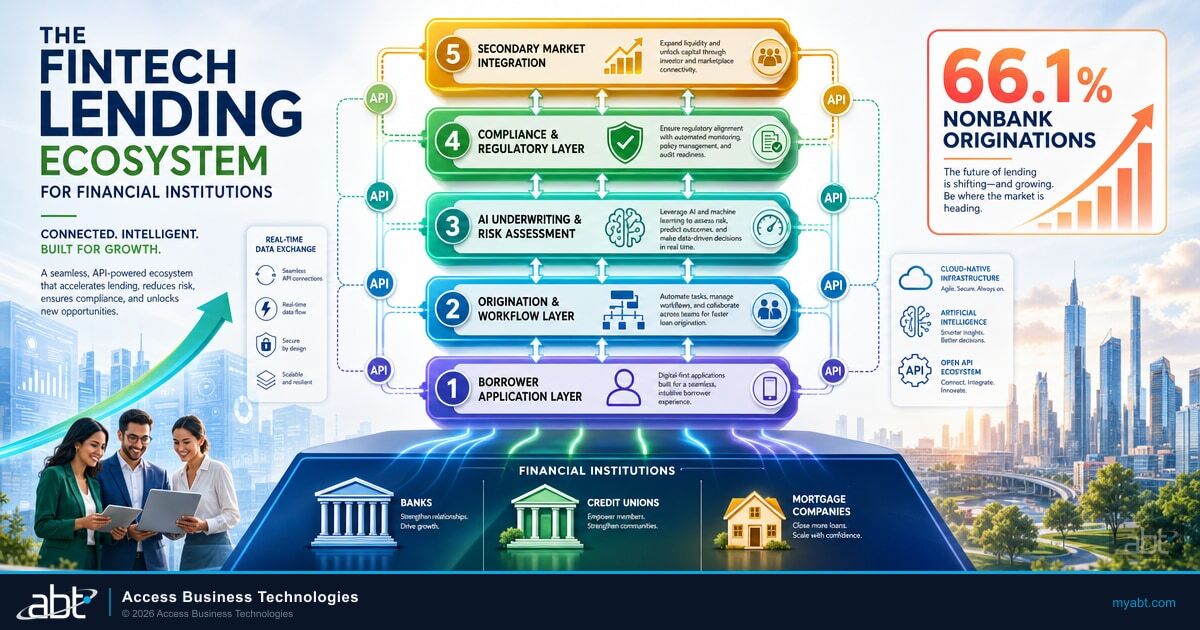
This article maps the fintech mortgage ecosystem layer by layer. For each component, it covers what the technology does, how it connects to the next layer, and where mortgage operations teams should focus investment in 2026. It also covers how Access Business Technologies, the largest Tier-1 Microsoft Cloud Solution Provider in the mortgage industry, builds that integration spine for more than 750 banks, credit unions, and mortgage companies through three productized layers: MortgageExchange, Mortgage BI, and MortgageWorkSpace.
The Borrower Application Layer
Modern borrowers arrive with research already done. They have compared rates online and they are ready to move forward, but only if the application matches their expectations for speed and convenience. The numbers reflect this: 92% of homebuyers use online methods during their mortgage journey. Over one-third complete applications entirely online.
The best borrower-facing platforms share common traits. They are mobile-first, letting borrowers start on a phone and finish on a desktop without losing progress. They use consumer-permissioned data services like Plaid, Argyle, and Truv to verify income and assets instantly. They provide real-time status tracking so borrowers know exactly where their application stands.
Sixty percent of borrowers now engage in mortgage-related activities from mobile devices. A platform that treats mobile as secondary is not competitive. Leading mortgage applications complete the 1003 in under 5 minutes by prefilling data from verified sources and only asking borrowers for information the system cannot pull automatically.
OCR technology paired with AI transforms document collection. Borrowers snap a photo of a pay stub. The system reads it, extracts the data, and flags any issues in seconds. That is a different experience from uploading a PDF into a portal and waiting for a human to open it.
The Fintech Mortgage Origination and Processing Layer
Behind the borrower interface, the origination layer is where verified data becomes a loan file. Loan Origination Systems like Encompass, MeridianLink, and Calyx Path serve as the central nervous system, connecting every step from application intake through closing.
The modern origination layer automates what processors used to do manually:
- Automated income verification: Systems pull and validate income data from payroll providers and tax documents without manual review.
- Document classification and indexing: AI sorts incoming documents by type, extracts key fields, and routes them to the correct loan file sections.
- Condition tracking: When underwriting generates conditions, the system identifies which documents satisfy them, requests those documents from borrowers, and tracks fulfillment.
- Workflow routing: Files move to the next team member based on loan type, complexity, and capacity. No manual assignment queues.
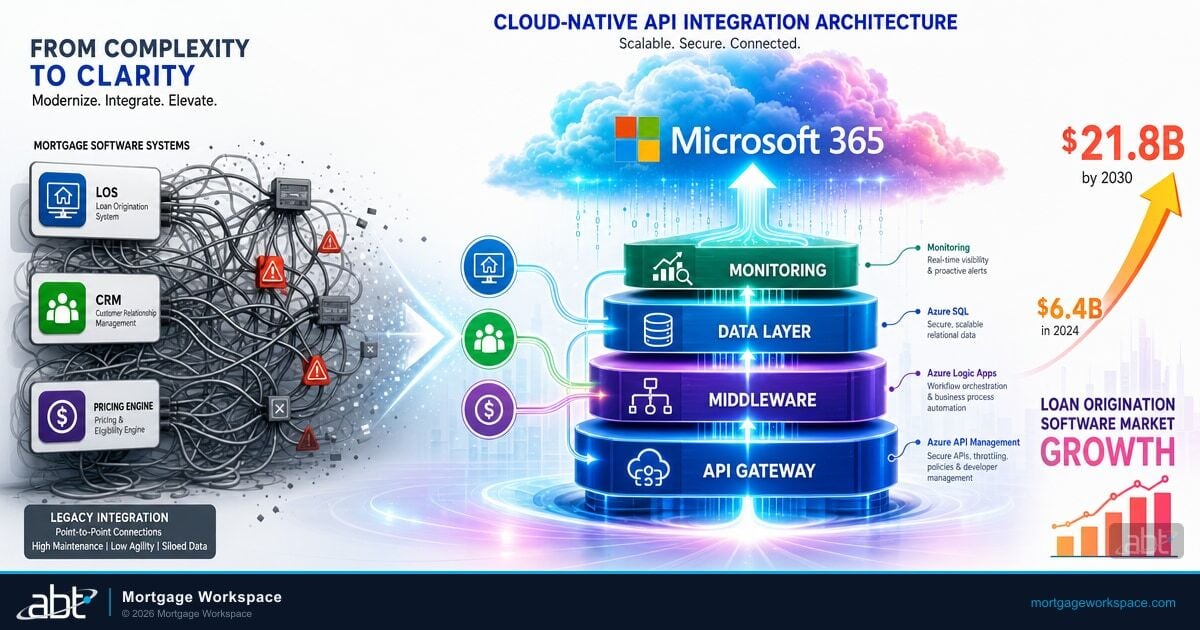
The fintech advantage in origination comes from API-first architecture. Instead of building everything into a single monolithic platform, leading lenders connect best-of-breed tools through standardized APIs. The best pricing engine connects to the best CRM connects to the best verification provider. This composable approach lets lenders innovate faster than competitors locked into all-in-one platforms.
AI Underwriting and Risk Assessment
AI-powered underwriting systems analyze borrower data with a depth and speed that manual review cannot match. Research shows AI can predict loan acceptance with 85% accuracy and default risk with 75% accuracy. These systems do not replace human judgment. They enhance it by surfacing patterns and risks that might otherwise be missed.
Fannie Mae reports that 73% of lenders have adopted AI and machine learning tools. The adoption is not experimental. It is operational, covering compliance reviews, anomaly detection, and credit risk assessment.
The biggest impact shows up in complex files. Self-employed borrowers, investment property loans, and jumbo mortgages generate thick files with intricate income calculations. AI underwriting engines analyze Schedule C income, validate rental income against tax returns, and cross-reference bank deposits against reported income. This analysis prepares a complete package so the human underwriter makes a fast, informed decision rather than spending hours building the analysis from scratch.
Upstart AI models evaluate 1,600+ data points beyond traditional credit scores. Alternative credit data like utility payments, rental history, and employment patterns expands access for gig workers and borrowers with thin credit files. This is not about lowering standards. It is about measuring risk with better data.
The Compliance and Regulatory Layer
Every layer of the fintech mortgage ecosystem generates compliance obligations. Borrower data collection triggers privacy requirements. Income verification must meet investor standards. Disclosures must follow TRID timing rules. The compliance layer runs in parallel with every other layer, not as an afterthought at the end. We cover Tech Due Diligence for Fintech Mortgage Startups in a companion piece.
Modern compliance automation covers four functions:
- Disclosure management: Automated generation and delivery of Loan Estimates and Closing Disclosures within regulatory timelines. The system tracks delivery, confirms receipt, and manages tolerance requirements.
- Regulatory monitoring: AI tools that track regulatory changes and flag affected loan files. GLBA, FTC Safeguards Rule, state-specific regulations (like NYDFS), and GSE requirements all feed into the compliance engine.
- Audit trail automation: Every action, decision, and data change is logged automatically. When auditors need to trace a decision, the system provides the complete chain of evidence.
- Fraud detection: Machine learning models analyze document authenticity, income consistency, and identity verification. Up to 50% of detected mortgage fraud involves fabricated documents that look legitimate to basic scanners.
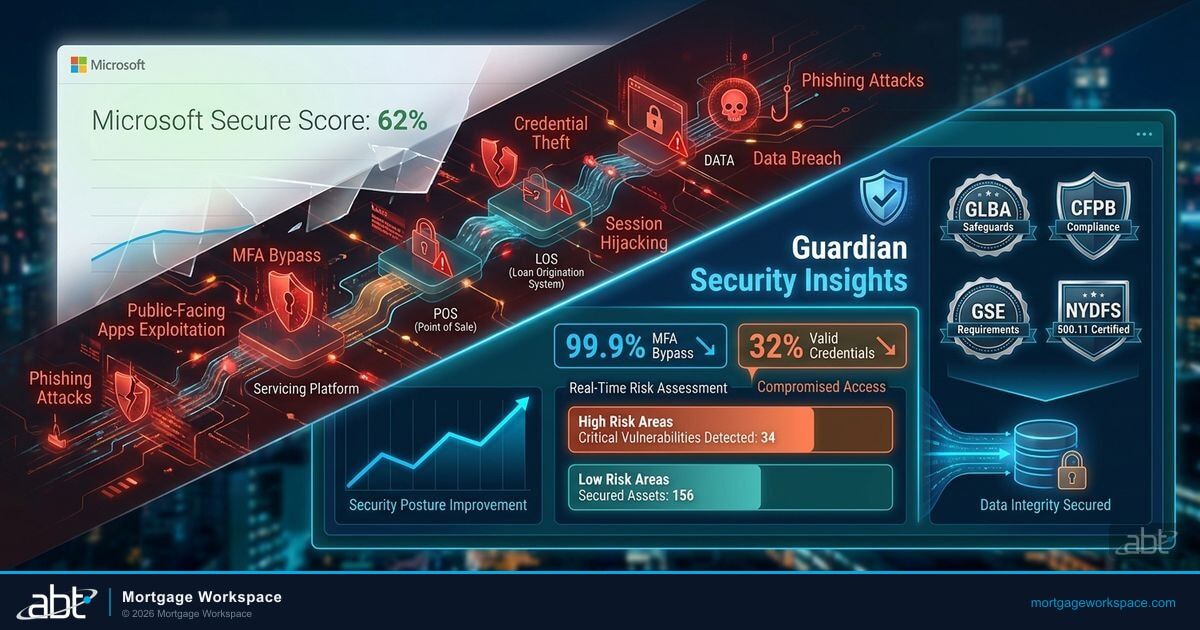
For mortgage companies, the compliance layer is where a fragmented tech stack creates the most risk. When systems do not share data, disclosure timing gaps appear. When document verification lives in a separate system, audit trails have blind spots. An integrated compliance layer prevents these gaps. ABT runs the compliance layer on Microsoft 365 with Microsoft Purview as the audit, retention, and DLP backbone. Microsoft Entra ID supplies the identity layer. Microsoft Defender and Microsoft Sentinel produce the detection signals and the incident timeline. The mortgage-specific configurations sit inside M365 Guardian, ABT's operating model for regulated financial services firms.
Secondary Market Integration and Delivery
The final layer of the ecosystem connects originators to the secondary market where loans are sold to investors. This layer has historically been the most manual, requiring physical document delivery, wet signatures, and paper-based investor due diligence.
Digital transformation is changing this rapidly. eClosing and eNotarization platforms handle document execution electronically. eVault systems store and manage electronic promissory notes. API connections between originators and investors enable electronic loan delivery that replaces overnight packages with real-time data exchange.
The efficiency gains cascade backward through the ecosystem. When secondary market delivery is digital, it creates incentives for every upstream process to be digital too. Paper documents at any stage create friction at the delivery stage. This is why lenders investing in front-end automation without addressing secondary market connectivity see diminishing returns.
Cash-out refinancing now represents 67.3% of the refinance market. As rate cuts drive refinancing demand, secondary market throughput becomes a competitive constraint. Lenders with digital delivery infrastructure process more volume without proportional staff increases.
API Architecture: The Connective Tissue of the Fintech Mortgage Ecosystem
APIs are what turn separate tools into an integrated ecosystem. Without them, every layer operates in isolation, generating data that has to be manually transferred to the next layer. With them, data flows from borrower application through secondary market delivery with minimal human intervention.
The mortgage industry is moving toward composable architecture. Instead of choosing one vendor's platform for everything, lenders connect best-in-class tools through APIs:
- Best pricing engine connects to the LOS
- Best verification provider connects to the borrower portal
- Best compliance engine connects to every layer
- Best eClosing platform connects to the secondary market
This approach lets lenders swap individual components without rebuilding the entire stack. When a better verification provider emerges, you integrate it through the API layer. When regulatory requirements change, you update the compliance engine without touching the origination system. Read more in our companion piece on the role of API gateways in modern mortgage lending platforms.
Over 90% of financial institutions now rely on APIs for customer experience delivery. One case study documented a financial services lender cutting transaction processing time from 48 hours to under 3 minutes through API integration. That is not a theoretical benefit. It is a production result.
The ABT Mortgage Platform: MortgageExchange, Mortgage BI, MortgageWorkSpace
The composable architecture in the previous section is the theory. The next two paragraphs describe how Access Business Technologies productizes that theory for the mortgage companies, banks, and credit unions ABT serves. Three named layers do the work: MortgageExchange as the integration spine, Mortgage BI as the analytics surface, and MortgageWorkSpace as the productized mortgage platform that ties Microsoft 365 to the mortgage workflow. For ABT's fuller take, see Building a Compliant IT Framework for Mortgage Companies.
MortgageExchange is ABT's integration spine. It connects borrower-facing apps to the LOS, the LOS to the AUS, the AUS to core banking systems like Fiserv DNA, Symitar Episys, and Jack Henry SilverLake, and the core to secondary market delivery channels including Fannie Mae, Freddie Mac, and aggregator pipelines. The point of a named integration spine is what it removes from the lender's plate: instead of contracting separately for every point-to-point connector, an integration data dictionary that drifts between systems, and a separate vendor for each handoff, the lender contracts for MortgageExchange and the spine carries the data end to end. The interface family is the largest single product surface inside ABT, and the operational pattern recognition from running it across 750+ FIs is what lets ABT add the next institution's tenant on top of a stable integration substrate rather than greenfield wiring on every deal.
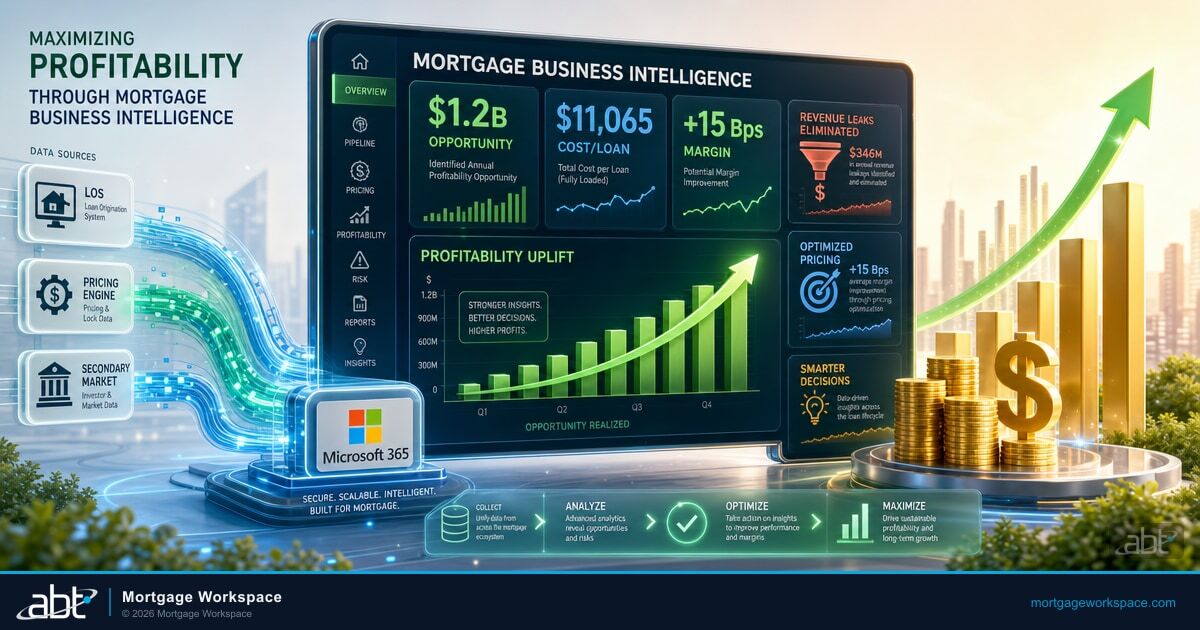
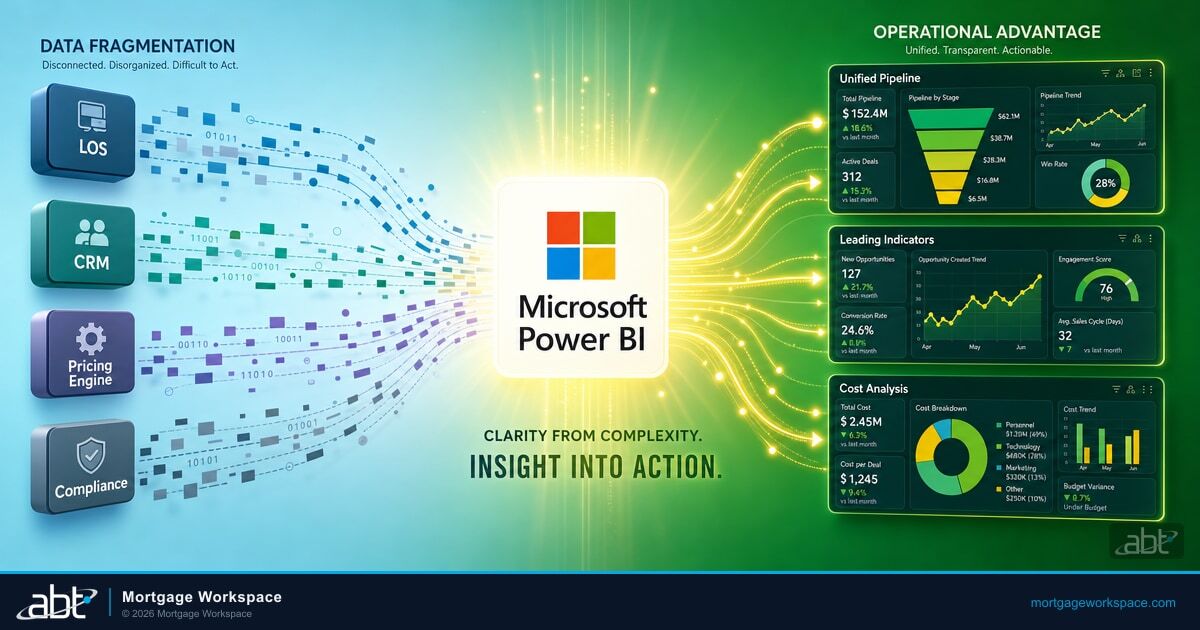
Mortgage BI and MortgageWorkSpace are the productized layers on top. Mortgage BI is the business intelligence layer that surfaces pipeline velocity, loan-officer performance, processor throughput, conditions-to-clear-to-close cycle times, branch profitability, and investor-delivery latency in dashboards that mortgage executives actually open every morning, rather than the static Encompass reports that update overnight. MortgageWorkSpace is ABT's productized mortgage platform sold through mortgageworkspace.com that bundles Microsoft 365, the M365 Guardian operating model, and the mortgage-specific integration plus reporting stack into a single subscription for mortgage companies that do not want to assemble the pieces themselves. The promise is the same one running across the entire article: productivity first, security to protect that productivity, governance as the byproduct. ABT manages the Microsoft 365 tenant, runs the integrations, applies the security baseline, and produces the audit evidence, while the mortgage company focuses on loans.
Map Your Fintech Mortgage Ecosystem with ABT
ABT runs the MortgageExchange integration spine, Mortgage BI dashboards, and MortgageWorkSpace productized mortgage platform for mortgage companies, banks, and credit unions across the country. A 30-minute conversation maps your borrower app to LOS to AUS to core to secondary market handoffs, surfaces where data is dropping between systems, and outlines what an ABT-managed deployment would cover. No commitment, no quote, no obligation.
Technical Reference
- API-first (composable) architecture: System design where separate best-of-breed tools connect through standardized programming interfaces, enabling modular assembly and real-time data exchange.
- LOS (Loan Origination System): Central platform managing the loan lifecycle from application through closing. Examples: Encompass, MeridianLink, Calyx Path.
- AUS (Automated Underwriting System): Fannie Mae's Desktop Underwriter and Freddie Mac's Loan Product Advisor. Algorithmic engines evaluating borrower risk profiles.
- eClosing/eNotarization: Electronic execution of closing documents and notarization, replacing wet signatures and physical document delivery.
- eVault: Secure electronic storage for authoritative copies of electronic promissory notes, required for secondary market electronic delivery.
- TRID (TILA-RESPA Integrated Disclosures): Federal regulations governing disclosure delivery timing and content in mortgage transactions.
- MortgageExchange: ABT's named integration spine connecting borrower-facing apps, LOS, AUS, core banking, and secondary market delivery.
- Mortgage BI: ABT's business intelligence layer for mortgage pipeline analytics and dashboards.
- MortgageWorkSpace: ABT's productized mortgage platform bundling Microsoft 365, M365 Guardian, and the mortgage integration plus reporting stack.
Key Takeaway
Individual tools do not create competitive advantage. The ecosystem does. A fast borrower app connected to a slow back office is a broken promise. A great LOS disconnected from the secondary market creates a delivery bottleneck. The lenders growing market share in 2026 are the ones building end-to-end ecosystems where every layer connects through APIs, every process is automated where possible, and every compliance requirement is built into the workflow rather than bolted on after. For mortgage companies that want the ecosystem without assembling it themselves, ABT productizes the integration spine as MortgageExchange, the analytics surface as Mortgage BI, and the bundled platform as MortgageWorkSpace, on top of a Microsoft 365 tenant ABT manages under the M365 Guardian operating model.
Frequently Asked Questions
The ecosystem has five connected layers: borrower application (mobile-first portals with real-time verification), origination and processing (LOS-centered automation), AI underwriting and risk assessment, compliance and regulatory automation, and secondary market integration and delivery. APIs connect each layer, enabling data to flow from application through investor delivery with minimal manual intervention. ABT productizes the connective layer as MortgageExchange, the analytics layer as Mortgage BI, and the bundled subscription as MortgageWorkSpace.
API-first architecture lets lenders connect best-of-breed tools instead of relying on a single vendor platform. This composable approach enables faster innovation because individual components can be swapped without rebuilding the stack. Over 90% of financial institutions now rely on APIs for customer experience. One lender cut transaction processing from 48 hours to under 3 minutes through API integration. ABT runs that connective layer for mortgage companies under the MortgageExchange product name, so the lender contracts once instead of building point-to-point connectors per system pair.
AI underwriting analyzes borrower data at a depth and speed beyond manual review. Research shows AI predicts loan acceptance with 85% accuracy and default risk with 75% accuracy. Modern models like Upstart's evaluate 1,600+ data points beyond credit scores. AI handles complex income calculations for self-employed borrowers and prepares complete analysis packages so human underwriters make faster decisions. The signals from those AI underwriting decisions also flow into the lender's pipeline dashboards, which is where Mortgage BI surfaces cycle times and conditions-to-clear-to-close metrics for the operations team.
Compliance automation runs in parallel with every ecosystem layer, managing disclosure delivery within TRID timelines, monitoring regulatory changes across GLBA, FTC Safeguards Rule, and state regulations, maintaining automatic audit trails, and detecting document fraud. Integrated compliance prevents the gaps that appear when systems do not share data, reducing audit findings and regulatory risk. For mortgage companies on Microsoft 365, ABT runs the compliance layer on Microsoft Purview, Microsoft Defender, and Microsoft Sentinel inside the M365 Guardian operating model.
Digital secondary market delivery creates pull-through pressure for upstream automation. Paper documents at any stage create friction at delivery. eClosing, eNotarization, and eVault systems enable electronic loan delivery that replaces overnight packages with real-time data exchange. With cash-out refinancing at 67.3% market share, throughput at the delivery stage becomes a competitive constraint during volume spikes. MortgageExchange is the connective layer ABT runs between the LOS, the AUS, the core, and the investor delivery channel so the lender does not lose data fidelity between systems at the final handoff.
MortgageWorkSpace is ABT's productized mortgage platform sold through mortgageworkspace.com. It bundles a Microsoft 365 tenant that ABT manages, the M365 Guardian operating model for security and compliance, and the mortgage-specific integration plus reporting stack (MortgageExchange and Mortgage BI) into a single subscription. A standard Microsoft 365 deployment gives a lender productivity tools. MortgageWorkSpace adds the mortgage-industry-tuned configurations, the integration spine between LOS and core, the dashboards mortgage executives expect, and the security baseline that examiners under GLBA, FTC Safeguards, NCUA, and state regulators are looking for. ABT runs all of it across more than 750 financial institutions.