In This Article
A regional lending team doubled loan volume in one year after they stopped re-entering the same borrower data into two systems and gave every team member a real-time view of the pipeline. They did not add headcount. They closed the gap between their loan origination system, their automated underwriting feed, their core banking platform, and their CRM, and the chaos that came with toggling between six screens turned into a controlled operation. That is the difference an integrated pipeline makes, and that is the operating shape Access Business Technologies has built for mortgage lenders running on Microsoft 365 for more than 25 years.
Why ABT Runs Pipeline Integration for Mortgage Lenders
- MortgageExchange is the cross-system integration layer ABT has built and operated since the early Encompass and Calyx integration era. It carries pipeline data between the LOS, the AUS, the core banking system, and the lender's CRM so every team member works from one current set of facts.
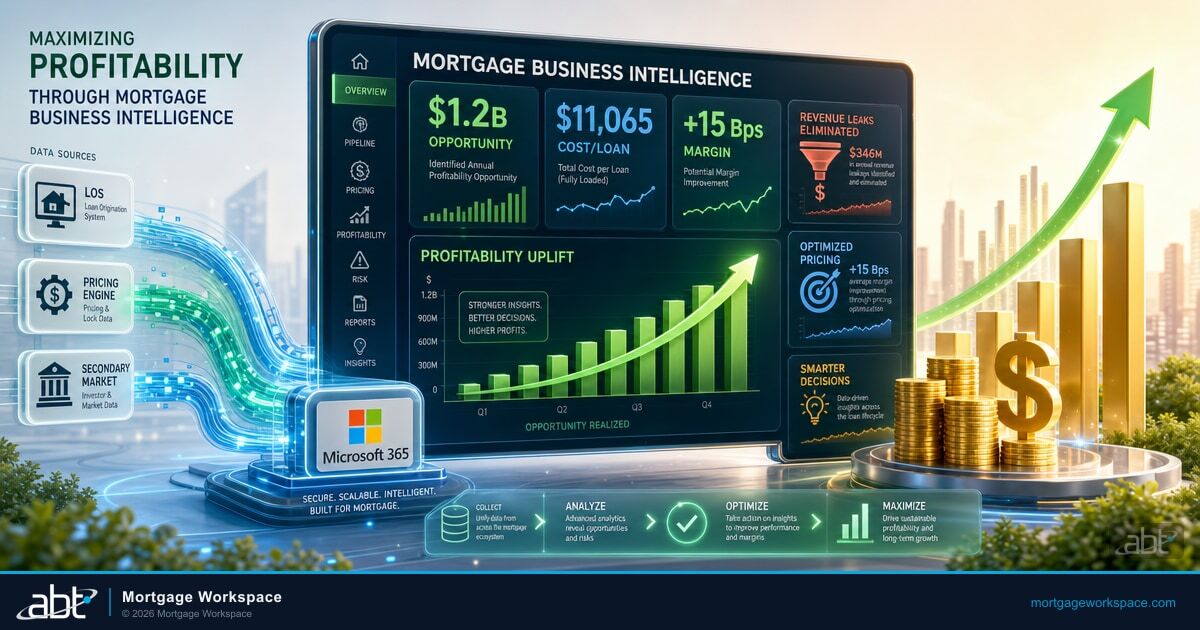
- Mortgage BI turns the integrated pipeline data into the dashboards a sales manager, an operations director, and a CFO can actually act on, including pull-through, time-to-close, and lock-to-fund forecasts.
- MortgageWorkSpace is the Microsoft 365-native workspace where the loan team lives day to day, with Outlook, Teams, SharePoint, and OneDrive configured for mortgage roles and bound to the same data ABT integrates underneath.
For mortgage professionals juggling applications, lender coordination, compliance checks, and borrower expectations, pipeline tracking can turn chaotic fast. When the systems behind the pipeline talk to each other, the chaos becomes a manageable workflow. This guide covers the structural problem disconnected systems create, the integration layer ABT operates for mortgage lenders, and the M365-native workspace where the integrated data actually gets used.
Understanding the Mortgage Pipeline
A mortgage pipeline tracks every loan from application through approval, underwriting, funding, and closing. Effective tracking tells you how many loans sit at each stage, which stage each loan occupies right now, what deadlines must be met this week, and what revenue the pipeline will produce based on expected closings. The concept is straightforward. The execution is not. With Fannie Mae projecting $2.32 trillion in mortgage originations for 2026 and refinance share climbing to 35 percent, pipeline visibility is the difference between capturing volume growth and drowning in it.
Why Disconnected Systems Break Pipeline Visibility
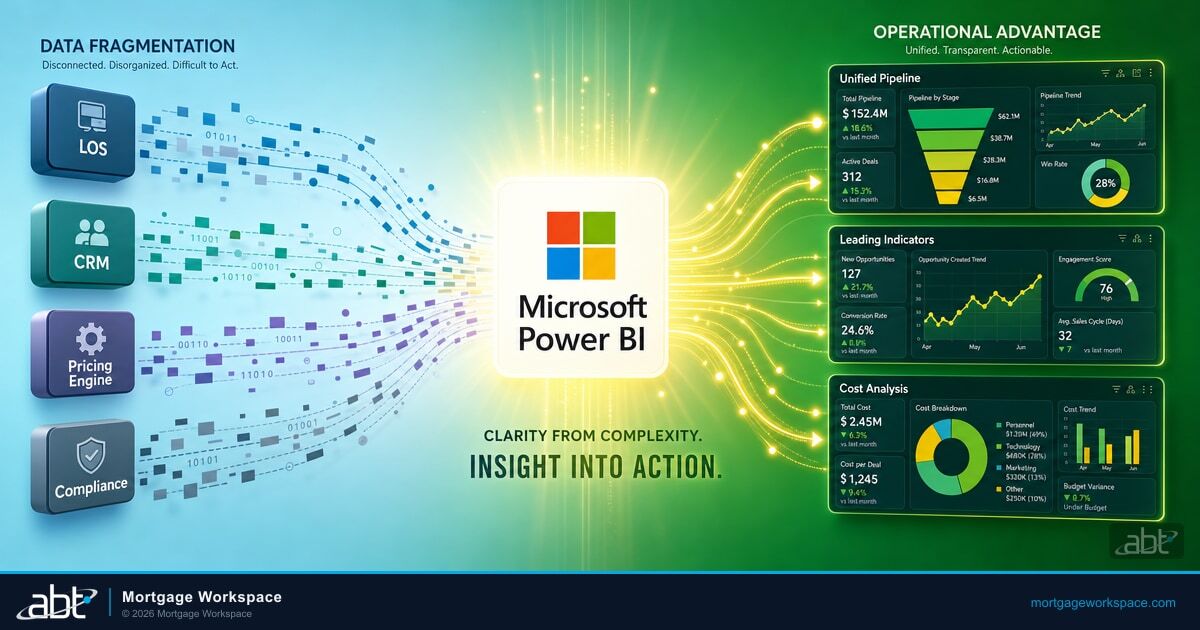
Mortgage operations run on multiple platforms. The loan origination system handles intake and processing. The automated underwriting system feeds back conditions from Fannie Mae or Freddie Mac. The core banking platform owns funded-loan accounting. The CRM owns borrower communication history and referral-partner activity. The pricing engine owns rate locks and concessions. Each of those systems was built by a different vendor with a different data model, and the disconnect creates measurable problems.
Data Silos
When loan data lives in one system and client relationship data lives in another, no single team has the full picture. Processors see loan status but not communication history. Sales sees lead activity but not underwriting conditions. McKinsey research confirms that borrower satisfaction drops by roughly 15 percentage points when communication is inconsistent or delayed.
Manual Data Entry Errors
Multiple disconnected systems mean data gets entered more than once. Each entry point creates error risk. A single typo in a borrower income figure can delay underwriting, trigger compliance flags, or derail a closing timeline.
Tracking Inefficiency
Switching between systems to find the latest status update wastes loan officer time. That time compounds across dozens of active files. One industry analysis found loan officers using integrated platforms save over seven hours of administrative work per file. We cover Integrating Financial Services Cloud with Mortgage Platforms in a companion piece.
Missed Deadlines and Compliance Risk
Without automated milestone tracking, delays go unnoticed until they become borrower complaints. Rate lock expirations, document deadlines, and disclosure timelines all slip when tracking depends on manual calendar entries. TRID mandates documentation trails for every data change, and when data flows through disconnected systems without centralized logging, compliance gaps appear at exactly the wrong audit moment. See also our breakdown of The Mortgage Industry's Best Kept Secret.
MortgageExchange: The Cross-System Integration Layer
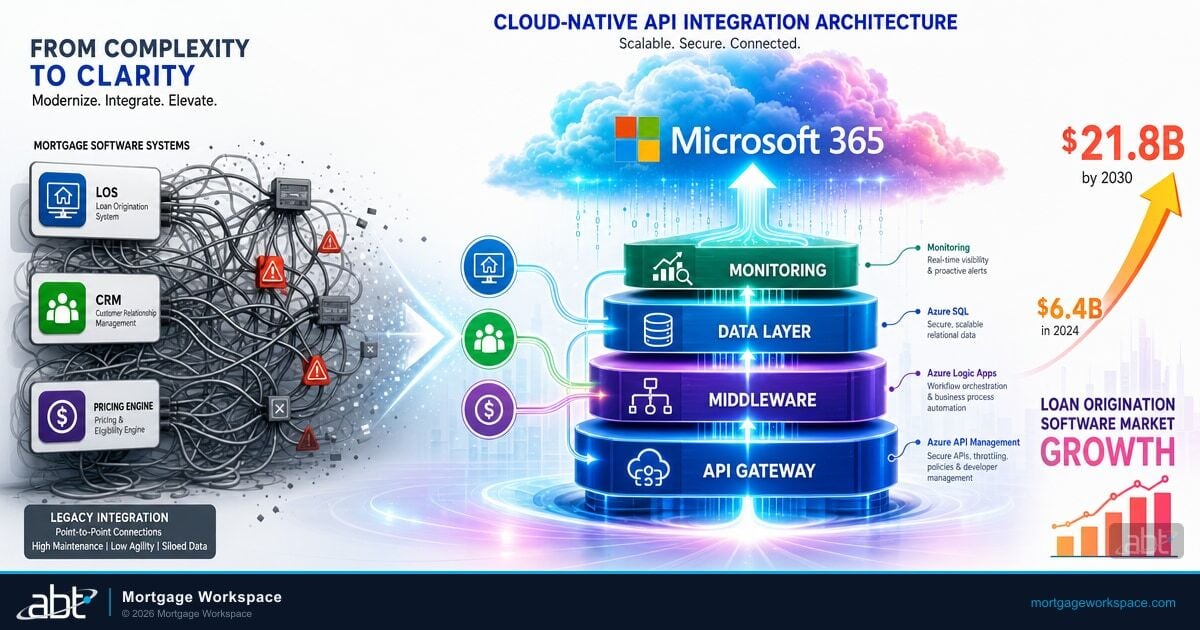
MortgageExchange is the integration layer ABT has built and operated for mortgage lenders since the early Encompass and Calyx era. It is the largest interface product in the ABT portfolio, and it sits between the systems that produce pipeline data and the workspace where the loan team lives. The LOS, the automated underwriting feed, the core banking platform, and the CRM each publish into MortgageExchange, and MortgageExchange publishes back out as a single coherent record per loan. When a loan officer updates a borrower contact, the CRM record updates and the LOS contact updates and the pipeline view updates. When the AUS returns a condition, the LOS picks it up, the processor task list reflects it, and the CRM logs the milestone for the borrower communication trail.
The structural job MortgageExchange does for the lender is to remove the duplicate-data-entry path that creates the silos, the errors, the missed deadlines, and the compliance gaps described above. The lender keeps its existing LOS, its AUS connection, its core banking platform, and its CRM. ABT operates the integration layer underneath. The mortgage operations leader stops choosing between fewer systems and better data, because MortgageExchange gives them both at once.
MortgageExchange has been the ABT cross-system integration layer for more than two decades of mortgage technology evolution, from the original Encompass and Calyx interface era through ICE Mortgage Technology's December 2026 SDK-to-API deadline. The integration carries pipeline data between the LOS, the AUS feed, the core banking platform, and the CRM under one governance model. Because ABT also manages the underlying Microsoft 365 tenant where the loan team works, with Microsoft Entra ID handling identity, Microsoft Defender watching the email channel, Microsoft Purview covering audit and retention, and Microsoft Intune covering the devices, the integration layer and the workspace it feeds are operated by the same partner. The lender does not coordinate three vendors to keep the pipeline visible.
Mortgage BI Dashboards and MortgageWorkSpace as the M365-Native Workspace
Integration is the foundation. Visibility on top of the integrated data is what mortgage operations leaders, sales managers, and CFOs actually use day to day. Mortgage BI is the dashboard layer ABT runs on top of MortgageExchange. It turns the unified pipeline data into the reports a sales manager uses to coach loan officers, the views an operations director uses to balance processor workload, and the forecasts a CFO uses to size warehouse line capacity. The dashboards are not generic BI templates retrofitted to mortgage data. They are built around mortgage-specific metrics: pull-through rate from lock to close, time-to-close by product type, lead response time by referral source, pipeline velocity by branch, and lock-to-fund revenue forecasts that roll up to the executive view.
Mortgage BI sits inside MortgageWorkSpace, the Microsoft 365-native workspace ABT configures for mortgage lenders. MortgageWorkSpace is not a separate application the loan team has to learn. It is the lender's existing Outlook, Teams, SharePoint, and OneDrive footprint, configured for mortgage roles and bound to the same integrated data MortgageExchange publishes underneath. A loan officer opens Outlook, sees the borrower thread, opens the linked loan file in SharePoint, jumps to the Teams channel where the processor is working, and pulls the current pipeline dashboard, all without leaving the M365 surface they already know. The processor, the underwriter, the compliance officer, and the branch manager each get the role-specific view of the same underlying data.
MortgageExchange integrates the data. Mortgage BI surfaces it. MortgageWorkSpace is where the team uses it.
A loan stalls in underwriting because the AUS returned a condition the LOS picked up but the CRM did not. The borrower calls the loan officer. The loan officer checks the CRM, sees no update, calls the processor, learns about the condition, calls the borrower back two hours later. The same situation repeats across 50 active files. The branch manager has no pipeline view at all. Our guide to Modern Loan Origination Systems Redefining Mortgage Efficiency goes deeper on this.
The same AUS condition lands in MortgageExchange. The LOS reflects it, the processor task list reflects it, the CRM logs it, and the borrower communication template fires automatically. The loan officer opens Mortgage BI inside MortgageWorkSpace and sees the loan flagged at the underwriting stage with the condition surfaced. The branch manager sees the same loan in their branch pipeline view. The borrower is contacted within 20 minutes instead of two hours.
Best Practices for Pipeline Efficiency
- Set clear metrics tied to pipeline velocity. Track time-to-close by product, pull-through from lock to close, conversion at each pipeline stage, and lead response time. Mortgage BI dashboards group these by branch, loan officer, and referral source so the conversation about what is working stays grounded in the data.
- Run weekly pipeline reviews with the integrated view on screen. When sales, operations, and compliance all look at the same Mortgage BI dashboard at the same time, the conversation moves from finger-pointing to coordinated action.
- Deploy role-based views inside MortgageWorkSpace. Underwriters, loan officers, processors, and compliance leads each need different lenses on the same pipeline. Give each role the view they need inside the M365 surface they already use.
- Separate purchase and refinance pipelines. Purchase deals involve appraisals, inspections, and fixed closing dates. Refinances move faster but depend on rate locks. Different workflows for different products prevent the cross-contamination of process expectations.
- Audit your TRID and Reg-Z documentation trail in Mortgage BI. Compliance officers can pull a per-loan audit view that shows every data change captured through MortgageExchange and bound to Microsoft Purview audit logging underneath, in the form an examiner will accept.
Key Takeaway
Pipeline visibility is not a software purchase. It is an operating shape. MortgageExchange integrates the LOS, the AUS, the core banking system, and the CRM under one cross-system layer. Mortgage BI turns that integrated data into the dashboards mortgage operations leaders, sales managers, and CFOs actually use. MortgageWorkSpace is the Microsoft 365-native workspace where the loan team uses both day to day. ABT operates all three under the same partner relationship for more than 750 financial institutions, so the lender stops coordinating vendors and starts running the business.
Get a Mortgage Pipeline Integration Review
ABT runs the MortgageExchange + Mortgage BI + MortgageWorkSpace operating shape described in this article for community banks, credit unions, and independent mortgage lenders. A 30-minute conversation maps your current LOS, AUS, core banking, and CRM footprint, surfaces the duplicate-data-entry paths costing the most time, and outlines what an ABT-operated integration would cover. No commitment, no quote, no obligation.
Frequently Asked Questions
MortgageExchange is the cross-system integration layer Access Business Technologies has built and operated for mortgage lenders since the early Encompass and Calyx interface era. It carries pipeline data between the loan origination system, the automated underwriting feed, the core banking platform, and the CRM, so every team member works from one current set of facts. The lender keeps its existing LOS, AUS, core, and CRM choices. MortgageExchange runs underneath as the integration layer, and ABT operates it as part of the same partner relationship that manages the Microsoft 365 tenant.
Mortgage BI is the dashboard layer ABT runs on top of the integrated pipeline data MortgageExchange publishes. It surfaces mortgage-specific metrics such as pull-through from lock to close, time-to-close by product type, lead response time by referral source, pipeline velocity by branch, and lock-to-fund revenue forecasts. The dashboards are built around mortgage operations, not retrofitted from a generic BI template, and they live inside MortgageWorkSpace so a loan officer, an operations director, or a CFO opens them without leaving Microsoft 365.
MortgageWorkSpace is the Microsoft 365-native workspace ABT configures for mortgage lenders. It is not a separate application. It is the lender's existing Outlook, Teams, SharePoint, and OneDrive footprint, set up for mortgage roles and bound to the integrated data MortgageExchange publishes underneath. ABT manages the underlying Microsoft 365 tenant as a Tier-1 Cloud Solution Provider, so identity, email security, audit retention, and device management all sit under one partner relationship. The loan team uses the surface they already know and the data the integration layer keeps current.
Yes. MortgageExchange has carried integrations with Encompass and Calyx loan origination systems since the early interface era of mortgage technology, alongside automated underwriting feeds to Fannie Mae Desktop Underwriter and Freddie Mac Loan Product Advisor, core banking integrations to Fiserv, Jack Henry, and FIS, and CRM integrations to the major mortgage CRM platforms. ICE Mortgage Technology's December 2026 SDK-to-API deadline for Encompass is a transition ABT is operating through for its existing customers, so the integration layer keeps publishing pipeline data through the cutover without the lender having to manage the migration internally.
Track time-to-close by product, conversion rate at each pipeline stage, pull-through rate from lock to close, lead response time, and average days loans spend in each status. Pipeline velocity measured weekly shows whether the operation is speeding up or stalling. Mortgage BI dashboards inside MortgageWorkSpace deliver these metrics with role-based filters, so a loan officer sees their pipeline, a branch manager sees the branch pipeline, an operations director sees the firm-wide pipeline, and a CFO sees the revenue forecast roll-up, all from the same integrated data feed.
TRID requires a documented trail for every change to disclosed loan terms. When LOS, AUS, core, and CRM data flow through disconnected systems, the trail fragments across vendors and the lender assembles it manually for audit. With MortgageExchange running as the integration layer, every data change is captured under one governance model and Microsoft Purview audit logging covers the M365 side, so the per-loan audit view inside Mortgage BI shows the full timeline. The compliance officer hands the examiner a coherent record instead of a multi-vendor reconciliation project.